
FIRE Explained Simply: A Practical Path to Financial Independence
FIRE stands for Financial Independence, Retire Early. Most explanations focus on saving a large percentage of income and investing slowly over decades.
That approach may work, but for many people it creates a long timeline, high stress, and delayed lifestyle flexibility.
At Power Couple Financial Coaching (PCFC), we take a different approach:
Fix cash flow first
Use growth to do the heavy lifting
Apply structure as your portfolio grows
Build flexible income over time
This page explains the framework. PCFC tools are designed to help you apply it.
What Most FIRE Advice Gets Wrong
Many traditional FIRE models rely on two ideas:
Save a high percentage of income
Reach ~25× your annual expenses
That 25× number comes from the 4% rule.
The 4% rule does adjust for inflation, but it still assumes:
withdrawals happen every year regardless of conditions
the portfolio stays largely static
no meaningful strategy adjustments are made
It’s not that the 4% rule is wrong. It’s that it assumes you don’t adapt.
The PCFC Framework: A Step-by-Step Path
Instead of focusing on one number, PCFC uses a progression.
Phase 1: Fix Cash Flow (Foundation)
Before investing becomes the focus, stability matters.
Goal:
Become cash-flow positive
Build a basic emergency reserve
Reduce reliance on debt
Without this step, everything else becomes fragile.
Use our free tools to:
track spending
eliminate negative cash flow
build a stable base
Phase 2: Grow to ~5× Expenses (First Real Milestone)
Most people believe they need the full FIRE number before life improves.
PCFC takes a different approach.
Instead of aiming for 25× first, focus on reaching about 30% of your target range.
16.6×0.30≈5
This means:
You are aiming for roughly 5× your annual expenses first
Why 5× Matters
At around 5×:
You are no longer starting from zero
Growth begins to have meaningful impact
Financial pressure starts to decrease
You gain flexibility in how you work and live
The goal is not to wait until the finish line. The goal is to improve your life along the way.
Why Growth Must Do the Heavy Lifting
If financial independence is the goal, there are only three levers:
how much you save
how fast your portfolio grows
how long it takes
Most FIRE advice focuses heavily on saving.
PCFC places more emphasis on growth in the early phase.
The Reality of Slow Growth
Using only traditional broad-market exposure may work over long periods.
However, slower growth often means:
needing a higher final target
contributing for more years
delaying flexibility
The PCFC View on Growth
Some investors choose to include higher-growth exposure during the early accumulation phase (for example, leveraged index exposure concepts such as QLD or SSO).
The goal is not speculation.
The goal is:
Allow growth to do more of the work so the required savings and timeline may be reduced.
What to Do in This Phase
Stay consistent with contributions
Accept volatility as normal
Avoid emotional decision-making
Focus on growth, not income
During this phase, the risk is often not the asset. The risk is abandoning the plan.
What Happens After 5×: Structure and Control (TAS)
Once your portfolio reaches meaningful size, the problem changes.
Early on:
You are trying to grow.
Later:
You are trying to avoid losing years of progress.
The Problem Most Investors Face
Traditional approaches often stay fully invested at all times.
This means:
large drawdowns are accepted
recovery can take years
progress may stall
The PCFC Solution: TAS
PCFC uses a structured system (TAS) to address this phase.
The goal is not to predict every move.
The goal is to:
participate in stronger market conditions
reduce exposure during weaker periods
follow rules instead of emotion
Avoiding large losses can be just as important as capturing gains.
Why This May Matter
Over time, reducing large drawdowns may:
preserve capital
shorten recovery periods
improve long-term outcomes
Why PCFC Uses a Different Target Range
Traditional FIRE discussions often reference a target around 25× annual expenses. That number comes from the 4% rule, which is based on historical studies using fixed withdrawal strategies over long periods.
Those studies were designed to answer a very specific question:
“What withdrawal rate would have survived past market conditions using a largely fixed approach?”
That is useful information. But it is not the only way to approach financial independence.
What the 25× Framework Assumes
The traditional model generally assumes:
withdrawals continue every year, adjusted for inflation
the portfolio remains largely static
limited adjustment based on market conditions
no structured approach to managing major drawdowns
It is a model built around consistency, not adaptability.
The PCFC Approach
PCFC uses a different framework built around:
growth doing more of the work early
structured decision-making as the portfolio grows
reducing large drawdowns when possible
adapting to changing conditions over time
Instead of aiming for one fixed number, PCFC often discusses a range around ~16× as a point where:
income can be supported from multiple sources
growth can continue
decisions can be adjusted over time
Core Idea
This is not about accepting less safety. It is about using a different system.
Why This Works Differently
The PCFC framework does not rely on a single assumption.
It considers:
higher-growth phases earlier in the journey
structured approaches to manage risk (such as TAS)
the ability to adjust withdrawals, income sources, and exposure
changing environments, including interest rates and yields
Outcomes are influenced by decisions over time, not just one starting number.
A Comparison
25×:
based on fixed historical modeling
designed to work without changes
16× (PCFC framework):
based on growth + structure + adaptability
designed to be actively managed over time
Final Thought on This
The difference is not certainty versus risk. The difference is a fixed system versus an adaptive one.
Using Yield When It Makes Sense
In some environments, lower-risk instruments such as CDs or Treasuries offer meaningful yields.
When that happens, some investors choose to:
allocate a portion of their portfolio to those instruments
generate part of their income from yield
reduce the need to sell growth assets
If part of your income is covered by yield, the rest of your portfolio has more flexibility to grow.
Important Considerations
yields change over time
inflation affects real returns
conditions are not constant
This is why flexibility matters more than fixed rules.
The Real Risk Most People Miss
Risk is often described as volatility.
In practice, risk is often behavior.
Examples:
abandoning a plan during normal volatility
reacting emotionally to market movement
switching strategies repeatedly
selling at the wrong time
The investor’s behavior often matters more than the asset itself.
Putting It All Together
The PCFC path:
Phase 1: Fix cash flow
Phase 2: Grow to ~5×
Phase 3: Apply structure (TAS)
Phase 4: Reach flexible financial independence (~16× range)
Most plans focus on getting you there eventually.
PCFC focuses on getting you there sooner, while maintaining control along the way.
Phase 1 PCFC Financial Decision Tools
Phase 1 — Foundation
Fix cash flow, build savings, and stop financial stress
Phase 2 — Growth
Start building assets and learn how investing actually works
Phase 3 — Protection
Protect what you’ve built and avoid major financial mistakes
Phase 4 — Income
Turn assets into income while continuing to grow
Phase 2 PCFC Financial Freedom Roadmap Calculator
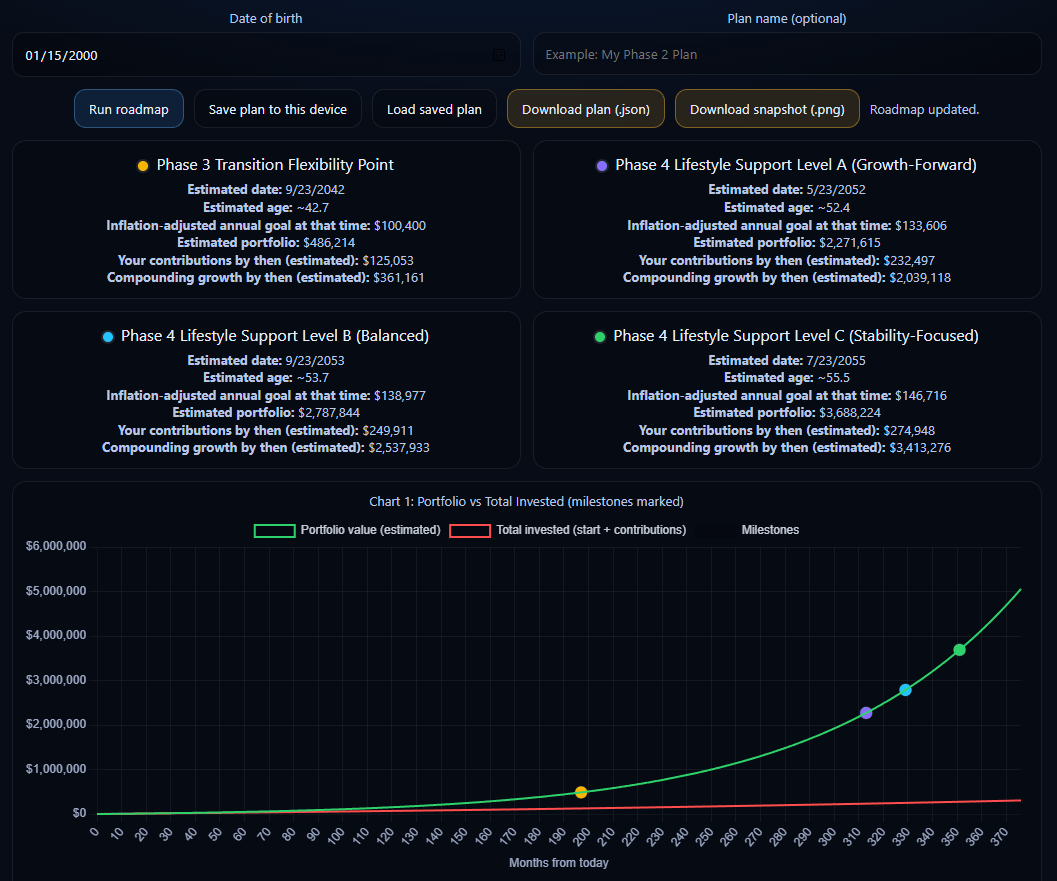
The image below is an example view from the PCFC Financial Freedom Roadmap Calculator.
This tool helps map your progress, estimate phase transitions, and show how contributions and growth work together over time.
It is one of several tools included inside the PCFC Complete System.
Power Couple Financial Coaching provides educational information only. Nothing on this page constitutes financial, investment, tax, or legal advice. All investments involve risk, including loss of principal. Examples are illustrative only and not guarantees of future results.